

Traceability Has Become a Business Requirement
If you work in ESG, CSR, compliance, or sourcing, the challenges are familiar:
- Recycled content percentages need verification.
- Certified cotton depends on complete transaction certificate trails.
- Digital Product Passports are approaching implementation.
- Supplier data spans several tiers and tools.
Most of that information lives across emails, folders, and spreadsheets. Documents come in different formats. Facility roles are sometimes unclear and quantities do not always align. Traceability organizes these moving parts into one structured workflow:
- Each purchase order is linked to the suppliers involved.
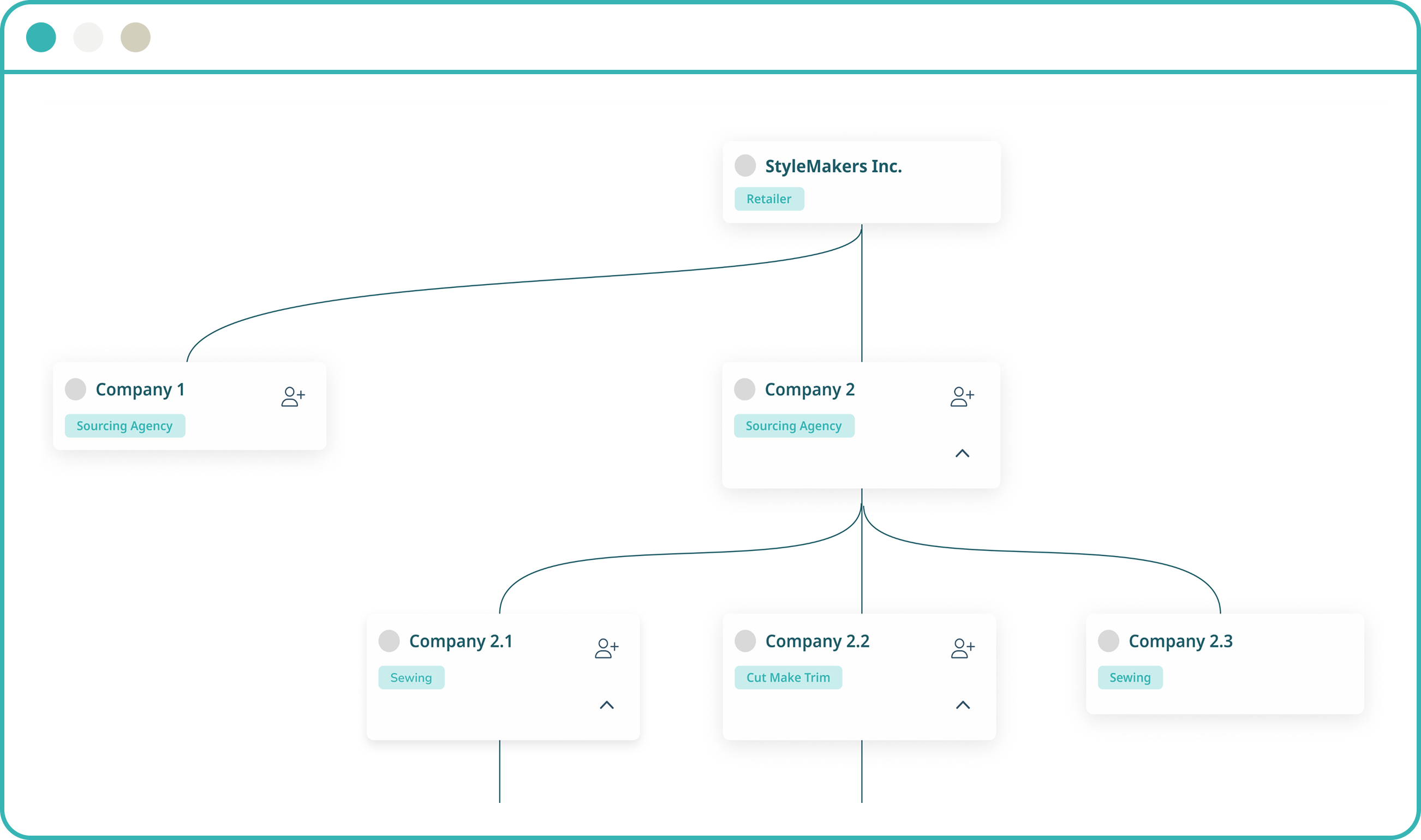
- Those suppliers are connected to the facilities that processed the material.
- Relevant documentation is attached at every step.
- Finished products reflect the full production story behind them.
This allows teams to validate claims before products reach customers.
Who Needs Traceability?
Traceability is not owned by one team as it affects everyone who manages supplier or product data.
You need to stand behind your claims. Recycled content, certified materials, and footprint disclosures all depend on supplier data that can be traced back to production.

You need documented chain of custody and supporting certificates in case of audits or regulatory checks.

You need to know which facilities are involved in a purchase order and whether certified volumes match production volumes.

You need oversight even if you do not want to double the size of your team.
Suppliers need one place to upload transaction certificates and production documents instead of answering the same questions across different emails and portals.
Traceability works best when brands and suppliers collaborate in the same system, one system of truth.

What Traceability Means in Fashion
In simple terms, traceability means you can follow a material through the supply chain and show the documents that prove each step.
This includes:
- Where a material originated
- Which facilities processed it
- Which manufacturer used it
- Which purchase order it belongs to
- Which certificates support it
- Which finished product contains it
At the core is chain of custody.
Chain of Custody
Chain of custody documents every transfer and transformation of a material. Each step is supported by a document that confirms:
- Who handled the material
- What quantity was transferred
- What certification status applied
Recycled content claims depend on documented chain of custody. Without it, percentages remain estimates.

Material Traceability
Material traceability, for example cotton, requires visibility across ginning, spinning, weaving, dyeing, and cut-make-trim. Each stage must connect logically to the next.
If 10,000 kilograms of certified cotton enter the supply chain, the same volumes must be reflected across transaction certificates and purchase orders. Traceability makes that comparison possible.
Certified Materials and Transaction Certificates
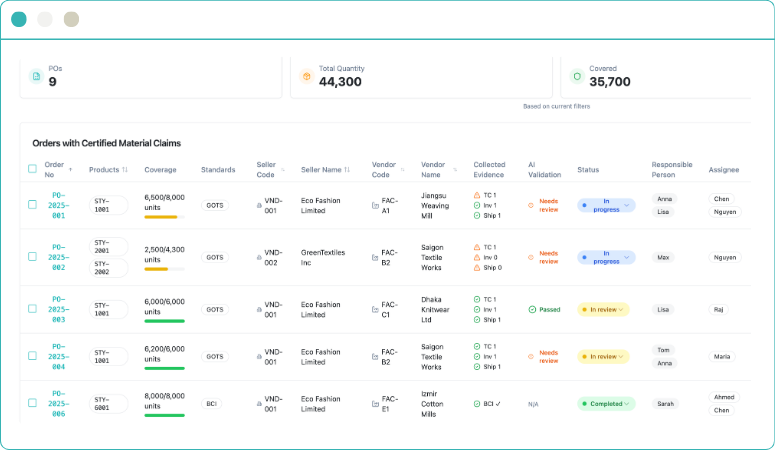
Certified materials require transaction certificates at each transfer point. These certificates confirm material type, quantity, and certification status.
The only reliable way to confirm recycled content in a product is through documented chain of custody supported by transaction certificates.
Traceability systems connect those certificates directly to purchase orders and finished products so teams can validate claims before products reach the market.
How Traceability Works in Practice

Supplier Mapping
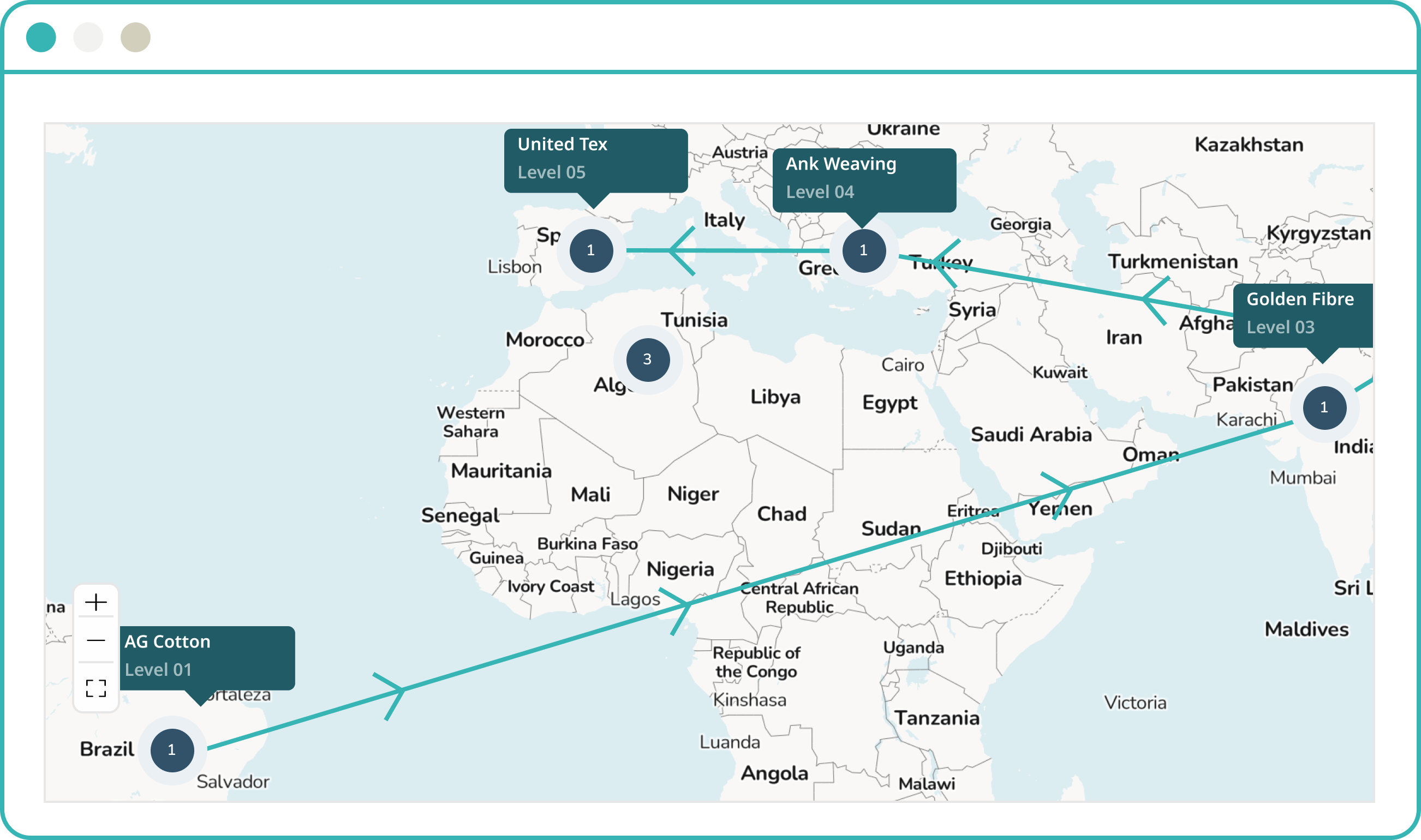
Facilities are mapped across tiers. Roles are defined clearly. Brands can see which spinner, mill, or dye house is connected to a specific purchase order.

PO-Level Tracing
Tracing at purchase order level links real production events to supplier and facility data. Claims are tied to documented orders rather than general supplier relationships.

Document Collection
Relevant documents are uploaded and organized in one place:
- Invoices
- Packing lists
- Bills of lading
- Transaction certificates
- Supporting compliance documents
Centralization reduces back-and-forth and duplicate requests.

Validation
Validation is where teams spend a lot of their time as they must check:
- Does the facility sequence make sense?
- Are the correct document types uploaded?
- Do quantities in certificates match the purchase order?
- Do buyer and seller names align?
Manually reviewing one purchase order thoroughly can take 60 to 90 minutes. Multiply that across hundreds of orders and the workload quickly becomes unsustainable. This is why scaling traceability requires automation.
Traceability and the Digital Product Passport
Digital Product Passports will require structured product-level data. For textiles, this is expected to include:
- Product identifiers
- Material composition
- Recycled content percentages
- Environmental footprint indicators
- Linked supporting documentation
This information must be supported by real supply chain data. Recycled content percentages depend on documented chain of custody. Environmental footprint disclosures rely on supplier-level inputs. Material composition claims require verified declarations from the facilities involved. Traceability connects supplier data, supporting documents, and product records so Digital Product Passports are grounded in evidence rather than isolated data points.
Upcoming Webinar
How AI Helps Scale Traceability for DPPs and Chain of Custody Compliance
We’re preparing a session on Digital Product Passports and Traceability in the fashion supply chain.
Leave your details to be the first to receive the event invitation. We will get in touch soon.
Scaling Traceability With Tracing AI
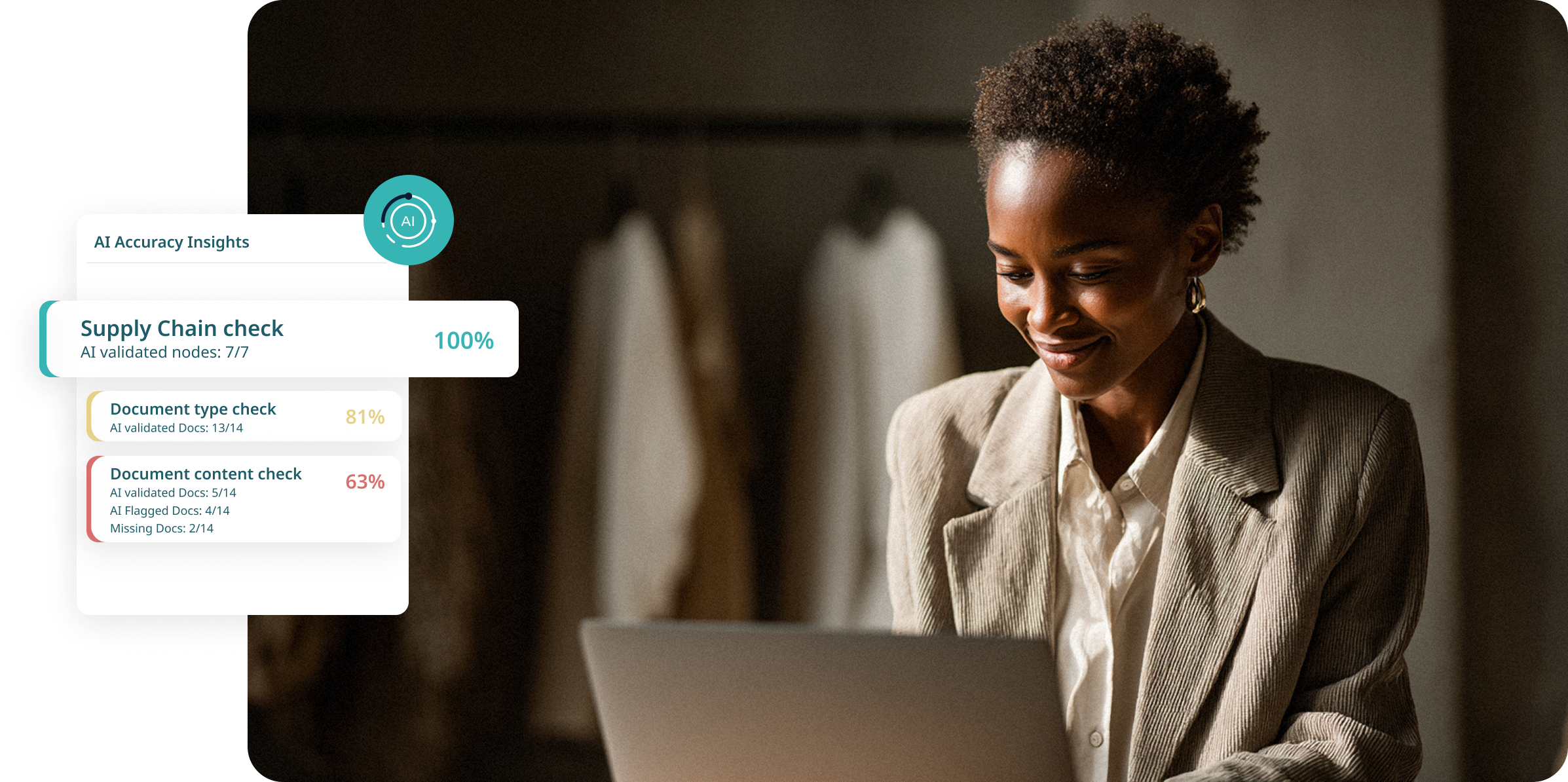
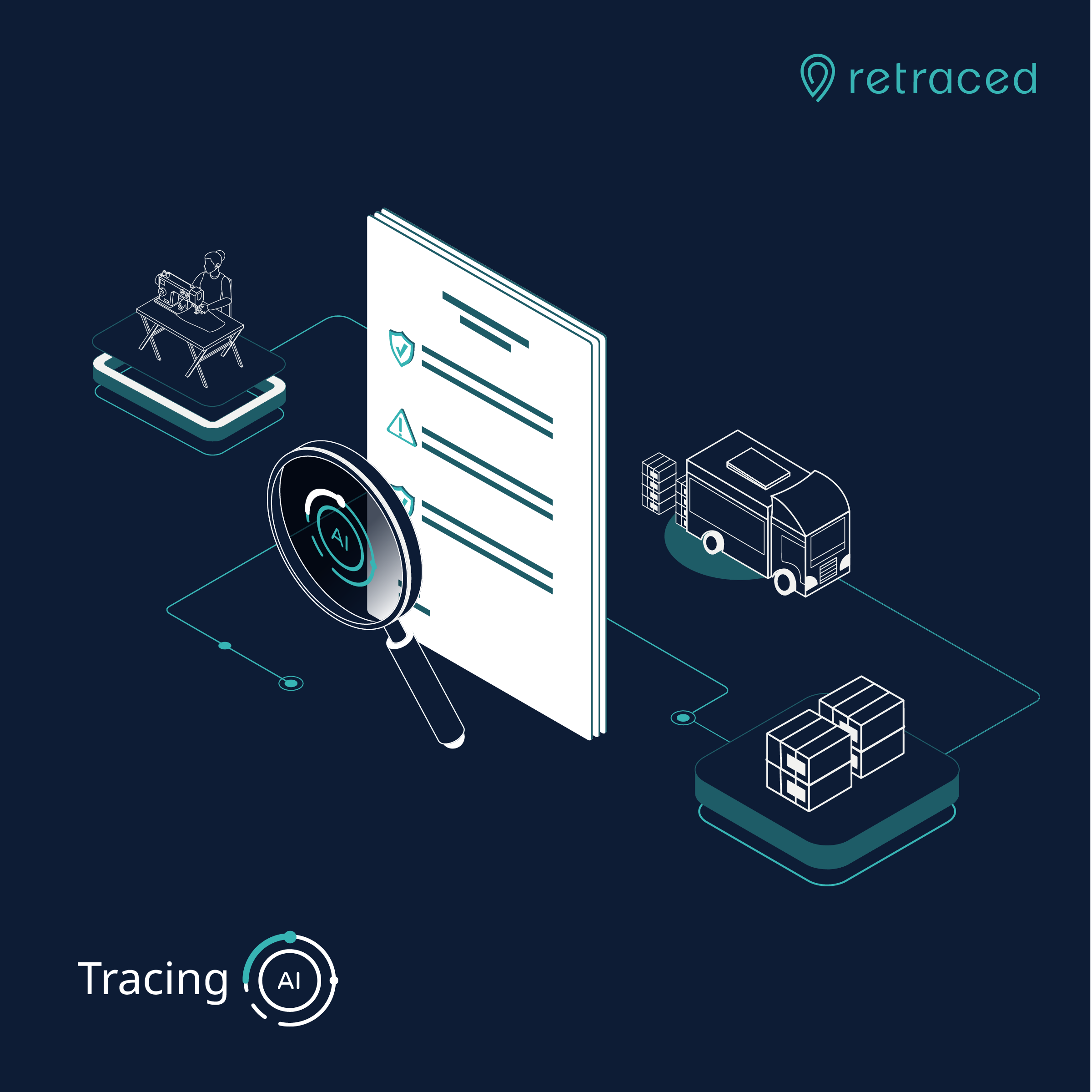
One purchase order can include dozens of files. Reviewing 30 to 100 documents manually may take hours, and fatigue increases the risk of missed inconsistencies. Tracing AI was developed to solve this operational bottleneck. It introduces automated validation across three layers

Supply Chain Accuracy Check
Tracing AI evaluates whether facilities and roles follow a logical sequence for the product in question.
Document Type Validation
Uploaded files are analyzed to confirm that the expected document types are present.

Document content analysis
AI reads the data inside documents. It detects inconsistencies in quantities, purchase order numbers, buyer and seller names, and other critical fields.
Watch Tracing AI in Action
In this short demo, discover how AI helps fashion teams validate purchase orders faster and reduce manual work.
How Much Time and ROI Could You Gain with Tracing AI?
This combination allows teams to focus on flagged issues instead of reviewing every page manually.
Review time per purchase order drops from up to 90 minutes to minutes.
That time reduction directly impacts your operational ROI.
Fewer manual review hours mean lower validation costs, faster approvals, and more capacity within the same team.
Use our Traceability Time-Saving Calculator to estimate how many hours your team spends on manual PO validation each year and what structured, AI-supported validation could return in measurable ROI.

Value for Brands and Suppliers
Tracing AI supports both sides of the supply chain. Suppliers receive feedback on documentation quality before issues escalate. This reduces repeated corrections and speeds up approvals.
Brands can scale tracing without adding full-time reviewers. As purchase order volumes increase, AI validation supports throughput while maintaining oversight.
Higher data quality strengthens collaboration across the supply chain.
Credits and Usage
Tracing AI operates on a credit-based model.
The number of credits used depends on purchase order and document complexity. Safeguards prevent excessive usage and support predictable cost management.
At launch, the platform shows how many credits were used per analysis. Teams decide when to trigger AI validation, and credits are applied accordingly.

Build a Traceability System That Scales
Retraced brings supplier relationship management, multi-tier mapping, AI-powered traceability, and certificate management into one collaborative system.
Need help?
Frequently Asked Questions
No. It supports review by flagging inconsistencies and missing information. Final decisions remain with your team.
Yes. It is designed for large PO volumes in the fashion industry and structured validation at scale.
No. Tracing AI is manually triggered, allowing teams to choose when validation adds value.
Structural irregularities, unexpected document types, and key data mismatches.
No. The calculator is a standalone resource designed to estimate documentation-related import exposure. It is not part of Retraced’s Risk Management feature.