

Time saved with AI
Your Tracing AI Savings Estimate is Ready
Enter your details to view now your PO Validation time-savings results
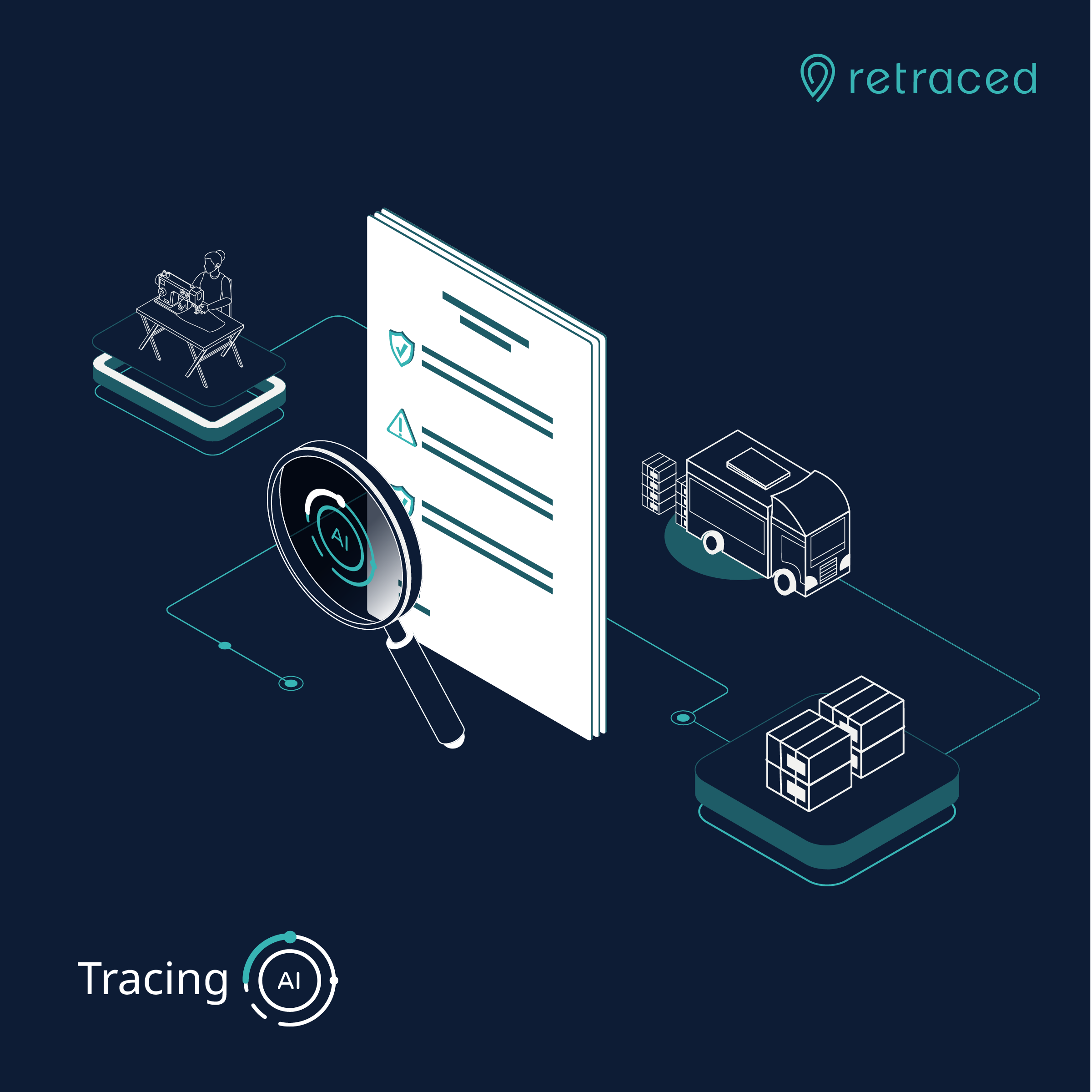
PO-Level Validation Is Becoming More Demanding
As brands trace beyond Tier 1, each purchase order links to more facilities, certificates, and supporting documents that must be reviewed. For many teams, this validation still relies heavily on manual checks. As tracing depth increases, review effort grows accordingly, and capacity planning becomes a practical constraint.
AI brings structure and consistency to PO validation. It supports teams in managing higher documentation volumes while maintaining control over the review process.
Watch Tracing AI in Action
In this short demo, discover how AI helps fashion teams validate purchase orders faster and reduce manual work.
Introducing Tracing AI: PO-Level Validation Built for Scale

Confirms expected document types
and formats

Reviews document content for key data alignment

Generates clear accuracy scores and summaries

Highlights where attention is required

Evaluates supply chain structure for logical consistency
Review time per PO can drop significantly. Instead of spending 60–90 minutes per PO, reviews happen in minutes.
That time reduction directly impacts your operational ROI. Fewer manual review hours mean lower validation costs, faster approvals, and more capacity within the same team.
Ready To See More?
Book a personalized walkthrough and explore:
- How Tracing AI integrates into existing workflows
- What accuracy scoring looks like inside a live PO
- How review time can be reduced while maintaining diligence
Traceability and the Digital Product Passport
Digital Product Passports will require structured product-level data. For textiles, this is expected to include:
- Product identifiers
- Material composition
- Recycled content percentages
- Environmental footprint indicators
- Linked supporting documentation
Upcoming Webinar
How AI Helps Scale Traceability for DPPs and Chain of Custody Compliance
We’re preparing a session on Digital Product Passports and Traceability in the fashion supply chain.
Leave your details to be the first to receive the event invitation. We will get in touch soon.
Explore AI in Traceability
Learn how brands are strengthening validation processes

TL;DR: Scaling fashion supply chains makes proving chain of custody harder as...
Read more
How Does AI Understand and Interpret Traceability Documents to Power Fashion Transparency?
TL;DR: AI-powered traceability turns fashion documentation into structured, c...
Read more
What Does Traceability AI Do and What Does It Check? Fashion’s Data Detective Explained
TL;DR: Traceability AI tracks and validates data, decisions, and actions acro...
Read moreNeed help?
Frequently Asked Questions
It uses inputs such as shipment volume, average shipment value, time spent on documentation review, and level of upstream supplier visibility to estimate your potential exposure to shipment delays, detentions, and rework. It is delivered as an Excel template with built-in formulas.
No. It supports review by flagging inconsistencies and missing information. Final decisions remain with your team.
Yes. It is designed for large PO volumes in the fashion industry and structured validation at scale.
No. Tracing AI is manually triggered, allowing teams to choose when validation adds value.
Structural irregularities, unexpected document types, and key data mismatches.
No. The calculator is a standalone resource designed to estimate documentation-related import exposure. It is not part of Retraced’s Risk Management feature.